


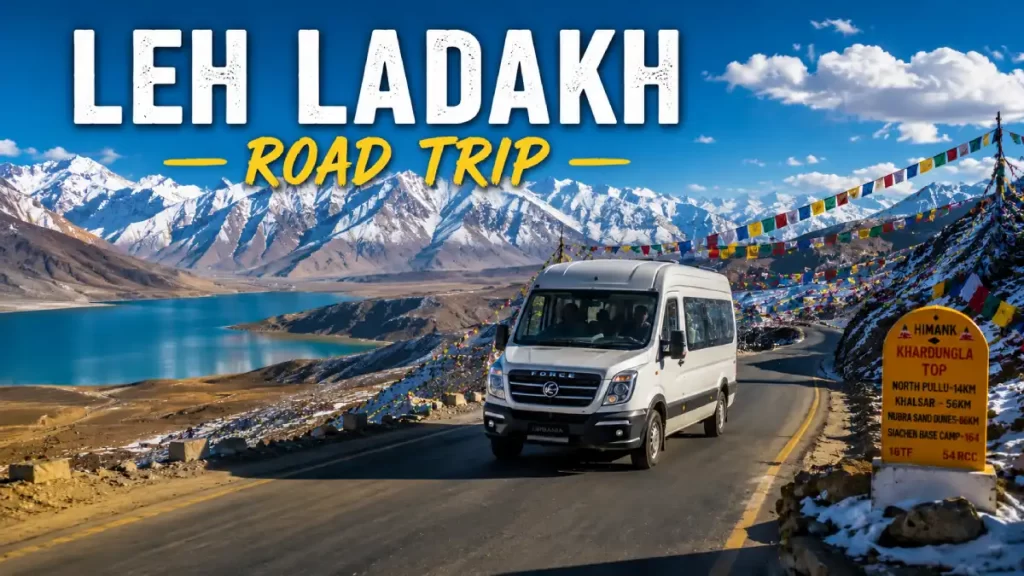
There are road trips, and then there is Leh Ladakh. India’s highest motorable plateau, ringed by the Himalayas and the Karakoram, is unlike any other destination in the country. Snow-dusted passes that touch 18,000 feet, glacial lakes that mirror the sky, monasteries perched on cliffs, and roads that test both machine and nerve- Ladakh rewards the traveller who chooses the road over the runway.
A 10-day Leh Ladakh trip from Delhi by road is widely considered one of the finest road journeys in the world. But it requires serious planning, a realistic budget, and above all else- the right vehicle. This guide gives you a complete, itemised breakdown of costs for different group sizes and travel styles, with special focus on why groups increasingly choose a Tempo Traveller or Force Urbania for this epic journey.
The Classic 10-Day Delhi–Ladakh Road Itinerary
Before breaking down costs, here’s the standard itinerary that most road-trippers follow:
| Day | Route | Highlights |
|---|---|---|
| Day 1 | Delhi → Manali (560 km) | Overnight drive / early morning start |
| Day 2 | Rest day in Manali | Acclimatisation, Hadimba Temple, Solang Valley |
| Day 3 | Manali → Jispa (110 km) | Rohtang Pass, Sissu, Keylong |
| Day 4 | Jispa → Sarchu (75 km) | Baralacha La (16,040 ft), Bharatpur Plains |
| Day 5 | Sarchu → Leh (250 km) | Lachalung La, Nakee La, Tanglang La (17,480 ft), Upshi |
| Day 6 | Leh local sightseeing | Shanti Stupa, Leh Palace, Leh Market |
| Day 7 | Leh → Nubra Valley (120 km) | Khardung La (18,380 ft), Hunder, Diskit |
| Day 8 | Nubra Valley → Pangong Tso (160 km) | Shyok River route, double-humped camels |
| Day 9 | Pangong → Leh (140 km) | Morning at the lake, Chang La |
| Day 10 | Leh → Delhi (via Manali, overnight) | Return journey begins |
This itinerary covers approximately 1,800–2,000 km of driving in total- a mix of highways, mountain passes, river crossings, and high-altitude plateau roads.
Complete Cost Breakdown: 10-Day Leh Ladakh Trip
1. Vehicle Cost (The Biggest Variable)
Your vehicle is not just transportation on this trip, it is your shelter, your comfort, your safety net. Here’s how different options compare:
Option A: Self-Drive (Rented SUV/Sedan)
- Rented SUV (Innova/Scorpio): ₹3,500–₹5,000/day = ₹35,000–₹50,000 for 10 days
- Fuel (approx. 2,000 km @ 10 km/l, ₹100/litre): ~₹20,000
- Total vehicle cost: ₹55,000–₹70,000 for 4–5 people
Pros: Maximum flexibility. Cons: Self-driving these roads is physically gruelling and risky if you are unfamiliar with mountain driving.
Option B: Hired Cab (Point-to-Point)
- Local cabs, multiple bookings: ₹8,000–₹15,000/day = ₹80,000–₹1,50,000
- Multiple cab changes mean multiple drivers, inconsistent experience
Option C: Tempo Traveller (Best for Groups of 9–14) ✅ Recommended
- Hire rate (Delhi to Ladakh, 10 days): ₹65,000–₹90,000 inclusive of driver + fuel
- Per person cost (12 people): ₹5,500–₹7,500 per person
- Includes: Experienced hill driver, fuel, toll charges, driver allowance
The Tempo Traveller– particularly newer models with push-back or semi-sleeper seats is built for long-distance mountain travel. Its diesel engine handles altitude and gradient better than standard petrol SUVs. The higher ground clearance manages river crossings and broken roads comfortably.
Option D: Force Urbania (Premium Group Travel) ✅ Recommended
- Hire rate: ₹80,000–₹1,10,000 for 10 days (Delhi departure)
- Per person cost (12 people): ₹6,500–₹9,000 per person
The Force Urbania Van Hire Delhi is the premium upgrade for group travel to Ladakh. With individual reclining seats, USB charging, ambient lighting, and wider windows for unobstructed mountain views, it transforms a gruelling journey into a memorable experience. Many travel companies now specifically offer Urbania Ladakh packages given the growing demand for comfort-oriented group travel.
Why choose Tempo Traveller or Urbania over multiple SUVs?
When a group of 12 books two SUVs, they split the group, miss shared experiences at each pass, deal with coordination issues, and end up paying similar or more money. A single Tempo Traveller or Urbania keeps everyone together, shares the experience fully, and costs less per head.
2. Accommodation Costs (Per Person Per Night)
Accommodation in Ladakh ranges from basic dormitories to boutique heritage hotels.
| Type | Cost Per Night (Per Room) | Per Person (Twin Sharing) |
|---|---|---|
| Budget guesthouse / homestay | ₹800–₹1,500 | ₹400–₹750 |
| Mid-range hotel | ₹1,500–₹3,000 | ₹750–₹1,500 |
| Premium / heritage hotel | ₹3,000–₹8,000 | ₹1,500–₹4,000 |
| Camping tent (Sarchu, Pangong) | ₹1,500–₹3,000/tent | ₹750–₹1,500 |
For 10 days (9 nights), budget per person:
- Budget traveller: ₹4,000–₹7,000
- Mid-range: ₹7,000–₹13,500
- Comfortable: ₹13,500–₹36,000
Note: At Sarchu (4,290 m), permanent structures are limited and camps are the standard accommodation. These are surprisingly comfortable with attached toilets, mattresses, and heaters.
3. Food Costs
Ladakh is not the place for culinary adventures on a budget. Food gets progressively more expensive as you gain altitude, because everything is transported from the plains.
| Location | Average Meal Cost Per Person |
|---|---|
| Delhi / Manali | ₹100–₹250 |
| Keylong / Jispa | ₹150–₹300 |
| Sarchu (camp meals) | ₹300–₹500 |
| Leh (restaurants) | ₹200–₹400 |
| Nubra Valley / Pangong | ₹250–₹500 |
Estimated food cost per person for 10 days: ₹4,000–₹8,000
Groups travelling by Tempo Traveller or Urbania often save on food by carrying snacks, dry fruits, instant noodles, and packaged meals for the high-altitude stretches where dhabas are scarce. This can bring food costs down by ₹1,500–₹2,000 per person.
4. Inner Line Permits and Entry Fees
Foreign nationals require an Inner Line Permit (ILP) for several areas in Ladakh. Indian nationals need permits for:
| Area | Permit Required | Cost (Indian National) |
|---|---|---|
| Nubra Valley | ILP | ₹400–₹500 per person |
| Pangong Tso | ILP | ₹400–₹500 per person |
| Tso Moriri | ILP | ₹400–₹500 per person |
| Khardung La | No separate permit | — |
Total permit cost per person: approximately ₹1,000–₹1,500
Permits can now be obtained online via the LAHDC (Ladakh Autonomous Hill Development Council) website, saving considerable time at checkposts.
5. Toll & Rohtang Pass Permits
The Rohtang Pass requires a separate permit for vehicles entering from Manali:
- Rohtang Pass Permit (vehicle): ₹550 (diesel vehicles)- paid online via the Himachal Pradesh government portal
- Environmental fee: ₹200–₹300 per vehicle, collected at the gate
Divided among a group, this adds approximately ₹50–₹100 per person.
Additionally, toll on the Delhi–Manali highway (NH-3): approximately ₹700–₹1,000 for the vehicle one way.
Suggested Read: Ladakh vs. Spiti- Choose Best High-Altitude Desert
6. Activities and Sightseeing
Ladakh’s main attractions are largely free- the passes, the lakes, the monasteries. But there are paid experiences worth budgeting for:
| Activity | Cost |
|---|---|
| Double-humped camel ride (Nubra Valley) | ₹500–₹700 |
| Monastery entry fees (Hemis, Thiksey, Diskit) | ₹50–₹100 each |
| Shanti Stupa / Leh Palace entry | ₹50–₹100 each |
| Rafting on Zanskar / Indus River | ₹700–₹1,200 per person |
| ATV/Quad bike at Nubra | ₹600–₹1,000 |
| Paragliding (if available) | ₹2,000–₹3,500 |
Budget per person for activities: ₹1,500–₹5,000 depending on choices.
7. Medical and Altitude Essentials
This is non-negotiable. Altitude sickness (AMS) is a real risk above 3,500 metres.
- Diamox (Acetazolamide) tablets: ₹100–₹200 for a course
- Oximeter (portable): ₹500–₹1,000 (shared in group)
- Portable oxygen can: ₹300–₹500 per can (carry 2–3 per group)
- Medical kit (basic): ₹500–₹800
Budget: ₹800–₹2,000 per person
Total Cost Summary: 10-Day Leh Ladakh Trip by Road
| Expense Category | Budget (Per Person) | Mid-Range | Comfortable |
|---|---|---|---|
| Vehicle (Tempo Traveller, 12 pax) | ₹5,500 | ₹6,500 | ₹8,000 (Urbania) |
| Accommodation (9 nights) | ₹5,500 | ₹10,000 | ₹25,000 |
| Food (10 days) | ₹4,500 | ₹6,000 | ₹8,000 |
| Permits & Tolls | ₹1,500 | ₹1,500 | ₹1,500 |
| Activities | ₹1,500 | ₹3,000 | ₹5,000 |
| Medical essentials | ₹1,000 | ₹1,500 | ₹2,000 |
| Miscellaneous (shopping, tips) | ₹1,000 | ₹2,000 | ₹4,000 |
| Total Per Person | ₹20,500 | ₹30,500 | ₹53,500 |
Rule of thumb: Budget travellers should plan for ₹20,000–₹25,000 per person. Mid-range travellers should budget ₹30,000–₹40,000. Comfortable/premium travellers should plan ₹50,000–₹70,000 per person.
Why the Force Urbania is a Game-Changer for This Trip
If you’ve never taken a 10-day Himalayan road trip, let me tell you what you don’t expect: the exhaustion. Mountain roads are beautiful but taxing. Long hours of driving through dust, heat, and thin air take a toll. This is where the Force Urbania genuinely earns its premium.
With its individual reclining seats, passengers can sleep properly on overnight legs- something a regular Tempo Traveller or SUV cannot offer. The larger windows mean every person in the vehicle gets a panoramic view of Khardung La or Pangong Tso not just the window seats. USB charging means cameras, phones, and power banks stay charged at altitude where power outages in guesthouses are common.
For a trip this significant- one that many people do once in a lifetime- the incremental cost of a Force Urbania over a standard Tempo Traveller is ₹1,000–₹2,000 per person. That’s a negligible amount for the comfort differential over 10 days.
Money-Saving Tips
Travel in a group of 12–14 in a Tempo Traveller or Force Urbania to minimise per-person vehicle cost.
- Book well in advance– Ladakh trips from May to September see high demand; last-minute bookings inflate all costs.
- Carry dry rations From Delhi- almonds, dates, biscuits, instant oats to reduce reliance on expensive roadside dhabas.
- Share permits and entry fees As a group to manage documentation efficiently.
- Avoid peak season surcharges (mid-July to mid-August) by travelling in June or late September.
- Stay at homestays in Nubra and Pangong- they are cheaper than hotels, more authentic, and often include home-cooked Ladakhi meals.
When is the Best Time to Do This Trip?
| Month | Road Status | Crowd Level | Cost Level |
|---|---|---|---|
| May | Manali–Leh road opens (usually mid-May) | Low-Medium | Moderate |
| June | Fully open, pleasant weather | Medium | Moderate |
| July–August | Open, but monsoon affects some roads | High (peak) | High |
| September | Post-monsoon clarity, ideal weather | Medium-High | Moderate-High |
| October | Road closes after mid-October | Low | Low-Moderate |
| Nov–April | Road closed (fly only) | — | — |
Sweet spot: Mid-June or mid-September for the perfect balance of accessibility, weather, and cost. Leh Ladakh is one of the best places to visit in India in June July.
Final Word: Budget Well, Travel Far
A 10-day Leh Ladakh trip from Delhi by road is not cheap, but it is absolutely worth every rupee. It is the kind of journey that recalibrates your sense of scale, silence, and beauty. The key is honest budgeting: account for every category, build in a contingency buffer of ₹3,000–₹5,000 per person, and don’t cut corners on your vehicle.
Whether you choose a Tempo Traveller for its value and space, or a Force Urbania for its premium comfort, the shared experience of reaching Khardung La together, watching sunrise over Pangong Tso from the same window, and navigating the switchbacks of Tanglang La as a group- that is the soul of this trip.
The mountains don’t care how much you spent. But you will spend every rupee well.
Plan it right. Travel it together. Remember it forever.