


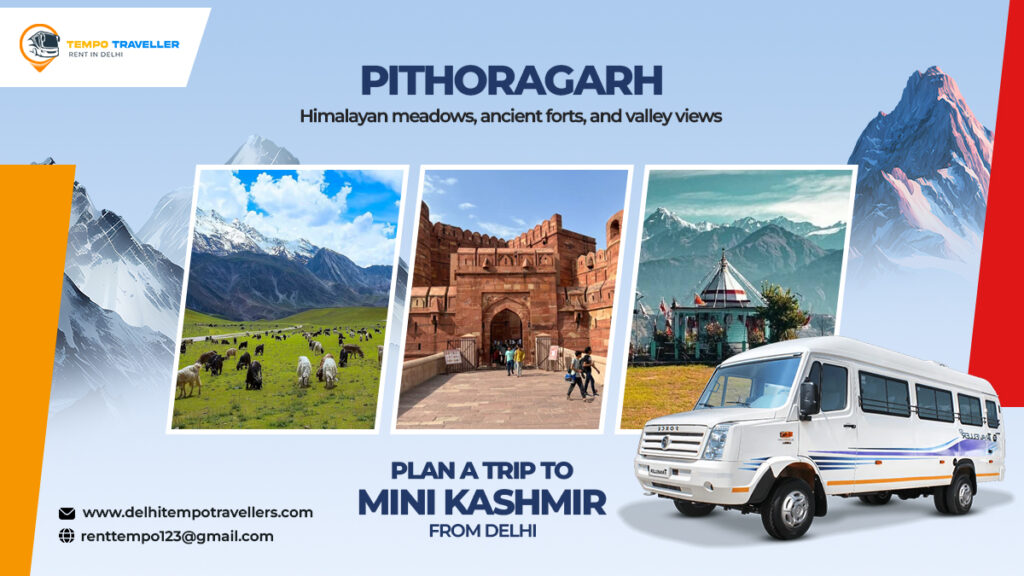
At the edge of India, where the mountains meet Nepal and Tibet, Pithoragarh Valley stands unhurried and magnificent.
📍 Delhi → Uttarakhand🛣️ ~500 km from Delhi⏱️ 10–12 hrs drive🗓️ Best: Apr – Jun & Sep – Nov
The name Kashmir carries a particular weight in the Indian traveller’s imagination- meadows of wildflowers, snow-draped peaks framing a wide valley, a quietness that seems to belong to another era. Most people assume you need to fly to Srinagar for that feeling. But tucked into the northeastern corner of Uttarakhand, sharing borders with Nepal to the east and Tibet to the north, there is a valley that earns the comparison completely and honestly. Find all trip details in this Pithoragarh Travel Guide.
Locals call it the Sausher Maidan– the flat land of soldiers- a wide, bowl-shaped valley surrounded on all sides by forested ridges and, beyond them, some of the most dramatic high-Himalayan peaks visible from any road-accessible town in India. Nanda Devi, Api, Nampa, Panchachuli- on a clear morning, standing at the fort or the Chandak ridge, these peaks don’t just appear in the distance. They fill the sky.
Pithoragarh is the district headquarters of the Kumaon Himalaya’s easternmost district. It’s a real tow- markets, temples, a buzzing chowk, but it carries none of the tourist-town exhaustion of the more famous Kumaon destinations. Come here and you will understand why those who discover it tend to come back, often, and quietly.
| 1,814m Elevation | ~500 km From Delhi | 5 peaks Visible from town | 10–12 hrs Drive from Delhi |
What Makes Pithoragarh the Mini Kashmir?
The comparison is geographical as much as emotional. Pithoragarh sits in a small, fertile valley- unusual for the Himalayan terrain of Kumaon, which is otherwise all ridges and steep drops. This valley, roughly 5km wide, is hemmed in by pine and oak forests and opens dramatically to snow-covered peaks on the northern horizon. The light here has the particular quality of high-altitude Himalayan towns- sharp, golden in the morning, and intensely blue by noon.

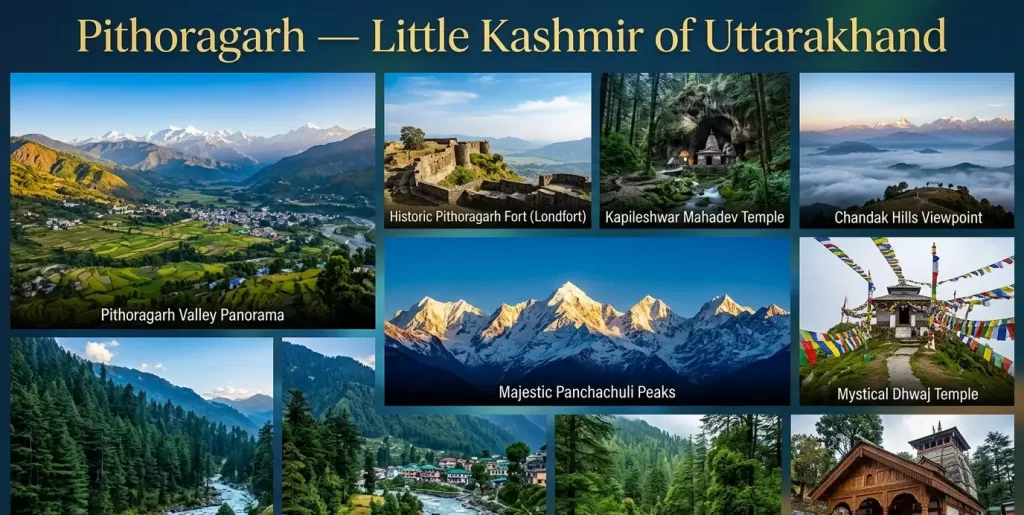
But Pithoragarh offers more than landscape. It is a town with genuine historical depth- a 16th-century fort built by the Chand kings that was later occupied by Gorkha forces and then the British. It has ancient temples with deep local significance- the Kapileshwar Mahadev cave temple, the Mosty Devi temple, the Ullागढ़ fort complex. It has a market where Tibetan traders once arrived with goods from beyond the Lipu Lekh Pass. And it serves as the base for some of the most spectacular trekking country in the Indian Himalaya, including the route to Adi Kailash and Om Parvat, the sacred mountain that carries a natural snow formation of the Om symbol on its face.
Places to See in Pithoragarh Town
Pithoragarh Fort (Londfort)
📍 Town Centre · 15 min walk from market
Built in the 18th century by the Gorkhas on the site of an older Chand-era structure, the Pithoragarh Fort- locally called Londfort- sits on a prominent hill overlooking the entire valley. The walk up is short but rewarding. From the fort walls, you get one of the finest 270-degree views of the surrounding peaks and the town spread below. The fort itself is partly in ruins but remains the town’s most atmospheric landmark.
Chandak Hill & Sunrise Point
📍 7 km from Pithoragarh · 20 min drive
Chandak is the ridge town above Pithoragarh, at about 2,000 metres, where Pithoragarh’s best Himalayan views are found. The sunrise from Chandak, with the Panchachuli massif turning pink and orange before the valley below has even woken up is one of those travel experiences that stays with you. Chandak also has a pine forest ideal for morning walks and a small, very peaceful temple. Plan to reach before 6 AM for the full effect.
Kapileshwar Mahadev Temple
📍 3 km from town centre · Easy 1 km forest walk
A Shiva temple located inside a natural limestone cave on the edge of a gorge, about 3 KM from Pithoragarh. The approach is a quiet forest path that feels deliberately removed from the town. The cave temple itself is small, dark, and genuinely atmospheric- a Shivalinga inside a natural cave with water trickling from the rock above. Deeply revered by locals and virtually unknown to outside tourists.
Dhwaj Temple & Thal Kedar
📍 25 km from Pithoragarh
Perched on a high ridge at around 2,100m, the Dhwaj temple dedicated to the local deity Dhwaj Devta offers sweeping valley views and a genuine sense of Kumaoni religious tradition. Nearby Thal Kedar, a Shiva temple, is also worth combining into a half-day loop. The drive up to these temples passes through dense rhododendron and oak forest.
Nearby Places to Explore from Pithoragarh
Pithoragarh’s greatest strength as a base is the extraordinary range of destinations within 50 to 150 Km of the town. This is where the trip truly opens up- each nearby destination is strikingly different from the last, and together they make a case for Pithoragarh as one of the finest base camps in the entire Indian Himalaya.
Nearby · 54 km
Munsiyari- The Little Kashmir Within Mini Kashmir
📍 54 km · ~2 hrs from Pithoragarh · Elevation: 2,200m
If Pithoragarh is Mini Kashmir, Munsiyari is where the analogy reaches its peak. Sitting at 2,200m on the edge of the Inner Himalayan zone, Munsiyari faces the Panchachuli massif in a way that is genuinely breathtaking- five snow peaks arranged in a perfect arc across the northern horizon. The town is the base for the famous Milam Glacier trek, one of the most rewarding long treks in the Kumaon Himalaya, and the shorter Khaliya Top trail, which rewards day hikers with an extraordinary ridge panorama. Don’t leave without visiting the Tribal Heritage Museum and the Nanda Devi Temple. Munsiyari alone justifies the drive from Delhi.
Nearby · 90 km
Adi Kailash & Om Parvat- The Sacred Circuit
📍 90 km via Dharchula · Requires Inner Line Permit
For those drawn to the intersection of high mountains and deep faith, the route from Pithoragarh towards Dharchula and onward to Om Parvat (6,191m) is as powerful as any journey in India. Om Parvat carries a natural formation of the Om symbol in permanent snow on its south face- visible clearly from the viewpoint at the base. Nearby Adi Kailash (5,945m), also called Chhota Kailash, is considered by many devout Hindus to carry the same sacred significance as the Mount Kailash in Tibet. The circuit requires an Inner Line Permit (arranged in Pithoragarh) and is best done as a dedicated 3–4 day extension from Pithoragarh.
Nearby · 74 km
Find Details: Triyuginarayan Temple Travel Guide
Dharchula- The Last Town Before Tibet
📍 74 km · ~2.5 hrs from Pithoragarh
Straddling the Kali River on the India-Nepal border, Dharchula is a frontier town with a rawness and energy that feels entirely different from the rest of Kumaon. The Kali River runs fast and turquoise below the town. Across the river, you can see Nepal’s Darchula town on the opposite bank. Dharchula serves as the entry point for the Adi Kailash and Milam Glacier routes, and the drive from Pithoragarh along the Kali valley through deep gorges, hanging waterfalls, and ancient villages perched on impossible slopes is spectacular in itself.
Nearby · 80 km
Narayan Ashram- Solitude at 2,734m
📍 80 km · Near Tawaghat, Dharchula route
Founded in 1936 by Narayan Swami, this ashram sits in a dense forest at 2,734 metres above sea level, overlooking the confluence of the Kali and Dhauliganga rivers. It runs a school for local tribal children and maintains a remarkable peace that is uncommon even in the Himalaya. The approach through the Kali valley is as beautiful as the destination. A stop here, even briefly, resets something.
Nearby · 65 km
Askot Wildlife Sanctuary
📍 65 km from Pithoragarh
One of the least-visited wildlife sanctuaries in Uttarakhand, Askot is home to the endangered musk deer, snow leopard, Himalayan black bear, and a remarkable range of high-altitude bird species. The sanctuary covers alpine meadows and steep forested slopes between 1,500m and 3,500m. For wildlife enthusiasts willing to look beyond the famous Corbett and Rajaji, Askot is a revelation- uncrowded, unmanaged for tourism, and entirely genuine.
Trek · 22 km from Town
Thal → Khaliya Top → Munsiyari Trek
📍 Starting point: Thal village, 22 km from Pithoragarh
One of the finest moderate treks in the Kumaon Himalaya, the Khaliya Top trail begins near Thal and climbs through rhododendron forests and alpine meadows to a ridge at 3,500m that offers arguably the best view of the Panchachuli range in the region. The full trail connects to Munsiyari and can be done in 2–3 days with camping, or as a demanding day hike to the top and back. In April and May, the rhododendrons in bloom along the trail are extraordinary. You can find best camping spots in Uttarakhand for a real adventure.
Birthi Falls
📍 35 km from Munsiyari
A 126-foot waterfall on the road between Pithoragarh and Munsiyari, set in a forested gorge. A natural roadside stop that most travellers pass quickly but deserves at least 30 minutes of your time.
Patal Bhuvaneshwar
📍 ~100 km from Pithoragarh
A mystical limestone cave temple dedicated to Lord Shiva, accessed by a steep descent into a cave network. One of Kumaon’s most extraordinary sacred sites- mentioned in the Skanda Purana. A must for those with an interest in cave temples.
Chaukori
📍 ~80 km from Pithoragarh
A quiet ridge village at 2,010m with tea gardens, panoramic Himalayan views, and almost no tourist infrastructure. The ideal overnight stop on the drive between Pithoragarh and the plains if you want to break the return journey beautifully.
Rameshwar Ghat, Thal
📍 22 km from Pithoragarh
The confluence of the Ramganga and Saryu rivers at Thal is a pilgrimage site that also serves as the trailhead for several Kumaon treks. A peaceful spot to sit by the river, especially early morning, before the day’s driving begins.
When to Visit Pithoragarh from Delhi?
April to June is the most popular window- rhododendrons bloom across the hillsides, the roads are clear after winter, and the Himalayan views are at their sharpest before the pre-monsoon haze settles. September to November is arguably the finest season- post-monsoon skies are luminously clear, the forests are lush and green, and tourist crowds are minimal. Winter (December to February) brings snowfall to Munsiyari, Chandak, and the higher trailheads, turning the landscape into something extraordinary- but road conditions can be challenging, and some routes towards Dharchula and Adi Kailash may be closed. The monsoon (July–August) should be avoided: the roads through the Kali valley and towards Munsiyari are prone to landslides, and many viewpoints are obscured for days at a time.
How to Reach Pithoragarh from Delhi?
Pithoragarh is approximately 490 to 510 Km from Delhi, depending on your route. The most commonly used road route goes via Haldwani and then through Almora or Champawat. The drive takes 10 to 12 hours, making it best approached as an overnight drive or an early morning departure.
| Route Segment | Distance | Approx. Time |
|---|---|---|
| Delhi → Moradabad (NH9) | ~167 km | 2.5 – 3 hrs |
| Moradabad → Haldwani / Kathgodam | ~80 km | 1.5 hrs |
| Haldwani → Almora | ~90 km | 2 hrs |
| Almora → Pithoragarh (via Berinag or Gangolihat) | ~115 km | 3 – 3.5 hrs |
| Delhi → Pithoragarh (Total) | ~500 km | 10 – 12 hrs |
🗺️ Route Tips: Two routes from Almora are worth knowing. The Almora → Berinag → Pithoragarh route (via Chaukori) adds about 30 minutes but passes through Chaukori’s spectacular ridge- highly recommended on the outward journey. The Almora → Gangolihat → Pithoragarh route is slightly faster and passes the remarkable Patal Bhuvaneshwar cave temple. Consider using one on the way out and the other on the return for variety.
By Train + Road
The nearest broad-gauge railhead is Kathgodam (near Haldwani), which is well connected to Delhi via the Ranikhet Express, Shatabdi, and other trains. From Kathgodam, Pithoragarh is about 185km- roughly 4 to 5 hours by road. For groups, it makes practical sense to drive the full distance from Delhi in a single vehicle rather than combining train and road logistics.
Why a Tempo Traveller or Urbania Van Works Best for Pithoragarh?
A trip to Pithoragarh- especially if you plan to explore Munsiyari, Dharchula, and the other nearby destinations is a multi-day, multi-road journey. The roads after Almora become progressively narrower and more demanding. Some stretches near Dharchula and the Kali valley are genuinely challenging, requiring a driver with experience on Himalayan Mountain roads.
For families and groups, the logistics of independent car travel in this region are significant. Parking is limited at most viewpoints, some inner roads are restricted to smaller vehicles, and coordinating multiple cars on mountain roads with patchy mobile connectivity is genuinely difficult. A single, well-driven vehicle with a route-familiar driver is not just convenient- it’s the right call.
Urbania Van- For the Long Mountain Drive
At 500km each way with significant mountain driving in the final 200km, the Force Urbania‘s superior ride quality, reclining seats, and better suspension make a real difference to how your group arrives. Whether you’re travelling with older relatives making a pilgrimage to Adi Kailash, or a group of friends planning a Munsiyari trek, the Urbania creates the right starting conditions. Our Urbania van hire in Delhi is available for outstation Pithoragarh itineraries- get in touch for a route-specific quote.
Tempo Traveller- For Larger Groups
For groups of 15 or more, the Tempo Traveller is the ideal vehicle for this route. Spacious, well-suited for mixed highway and mountain driving, and significantly more economical than multiple smaller vehicles for large groups. Our drivers for the Pithoragarh route have experience with the Kali valley roads, Munsiyari switchbacks, and the seasonal quirks of the Almora–Pithoragarh section. Book Tempo Traveller on rent in Delhi for the complete Pithoragarh circuit.
🏔️ Plan Your Pithoragarh Trip from Delhi
500km. Ten peaks. Five valleys. One vehicle from Delhi- fully driven, fully comfortable. Let’s plan your Kumaon circuit. Book Tempo TravellerRent Urbania Van
Suggested Itinerary- Delhi to Pithoragarh (5 Days)
Pithoragarh rewards a longer stay. A minimum of 4 nights lets you cover the town, Munsiyari, and at least one nearby destination without rushing. Here’s a suggested 5-day framework:
Day 1: Delhi to Pithoragarh
Depart Delhi by 5 AM. Drive via Moradabad, Haldwani, Almora. Stop for breakfast in Haldwani and lunch in Almora. Take the scenic Chaukori route for the final stretch. Arrive Pithoragarh by evening. Check in, evening walk to the fort or Chandak viewpoint for sunset.
Day 2: Pithoragarh Town & Surroundings
Sunrise at Chandak (leave by 5:30 AM). Morning visit to Kapileshwar Cave Temple and the fort. Afternoon at Dhwaj Temple. Evening stroll through Pithoragarh’s old market- try the local til (sesame) sweets and Kumaoni cuisine.
Day 3: Drive to Munsiyari
Full day drive to Munsiyari (54km, but 2.5 hrs on mountain roads). En route, stop at Birthi Falls. Arrive Munsiyari by afternoon. Walk to the Nanda Devi temple viewpoint for the Panchachuli panorama. Overnight in Munsiyari.
Day 4: Munsiyari Exploration / Khaliya Top
Full day in and around Munsiyari. Those wanting a trek can attempt Khaliya Top (return by afternoon). Others can visit the Tribal Heritage Museum, Maheshwari Kund, and the riverside meadows. Optional: drive towards Lilam for Milam Glacier views. Return overnight at Munsiyari or Pithoragarh.
Day 5: Return to Delhi via Chaukori / Patal Bhuvaneshwar
Early morning departure. Optional detour to Patal Bhuvaneshwar cave temple (100km from Pithoragarh, on the way back). Continue via Gangolihat, Almora, Haldwani. Reach Delhi by late night. For groups who prefer to break the return journey, overnight at Almora or Nainital.
📋 Practical Notes for Pithoragarh
- Inner Line Permit: Required for routes towards Dharchula, Adi Kailash, and the Kali valley. Obtain from the SDM Office in Pithoragarh- carry Aadhaar cards for all travellers.
- Cash: ATMs exist in Pithoragarh town but are often unreliable. Carry sufficient cash from Haldwani or Almora. Munsiyari has one or two ATMs; beyond that, cash is essential.
- Connectivity: BSNL and Jio work in Pithoragarh town. Connectivity drops sharply towards Munsiyari and Dharchula. Inform family before you head into deeper terrain.
- Altitude: Munsiyari (2,200m) and Khaliya Top (3,500m) involve meaningful elevation. Those with cardiac or respiratory conditions should consult a doctor before the trek portion.
- Booking ahead: Hotels and homestays in Munsiyari fill quickly in April–June. Book at least 2–3 weeks ahead if travelling in peak season.
Concluding Thoughts
There’s a particular silence that you find in Pithoragarh that you don’t find anywhere in the more visited hills. It’s not the silence of emptiness- the market is lively, the temples are busy, the children walking home from school fill the lanes with noise. It’s the silence of a place that hasn’t had to perform for tourists yet. The Panchachuli peaks don’t know they’re being photographed. The Kali River doesn’t know there’s a viewing platform. Pithoragarh, for all its beauty, is still simply a Himalayan town living its own life and that, after a week of Instagram-optimised travel, feels like the rarest thing in the world.
Planning your Pithoragarh circuit from Delhi? We can plan the full route- single or multi-destination in a comfortable Tempo Traveller or Urbania van with experienced mountain drivers.