

Eight days, roughly 1,400 km, and some of the most spiritually charged corners of Kumaon: this road trip starts in Delhi and threads through Bhimtal’s lakes, Neem Karoli Baba’s Kainchi Dham, the Mahavatar Babaji Cave, the temple town of Bageshwar and the Kali River frontier at Dharchula, before looping back through Tanakpur.
For many travellers, the pull is the cave near Dwarahat where, as told in Paramahansa Yogananda’s Autobiography of a Yogi, the deathless yogi Mahavatar Babaji initiated Lahiri Mahasaya into Kriya Yoga in 1861. But the route around it is just as rewarding: pine forests, terraced villages, Katyuri-era stone temples, river confluences and, on clear autumn mornings, a wall of snow peaks on the horizon.
Late September to early October is one of the best windows for this trip. The monsoon has washed the air clean, the hills are still green, and the Himalayan views return after months behind cloud.
Trip at a glance
Distances and drive times below are approximate and depend on road conditions, which can change quickly after the monsoon. Here is a long weekend plan suggestion during Vijayadashmi.
| Day | Date | Route | Approx. distance | Approx. drive | Night stay |
|---|---|---|---|---|---|
| 1 | 16 Oct | Delhi → Bhimtal | 300 km | 7–8 hrs | Bhimtal |
| 2 | 17 Oct | Bhimtal → Kainchi Dham → Dwarahat / Kukuchina | 110 km | 4–5 hrs | Near Babaji Cave |
| 3 | 18 Oct | Babaji Cave trek → Kausani → Baijnath → Bageshwar | 110 km + 5–6 km trek | 4–5 hrs | Bageshwar |
| 4 | 19 Oct | Bageshwar → Thal → Didihat → Jauljibi → Dharchula | 190 km | 7–8 hrs | Dharchula |
| 5 | 20 Oct | Local sightseeing: Narayan Ashram, Tawaghat | 100 km round trip | 5–6 hrs | Dharchula |
| 6 | 21 Oct | Local sightseeing: Kali river, Nepal-side Darchula, markets | Short drives | Relaxed | Dharchula |
| 7 | 22 Oct | Dharchula → Pithoragarh → Lohaghat → Champawat → Tanakpur | 240 km | 9–10 hrs | Tanakpur |
| 8 | 23 Oct | Tanakpur → Delhi (railway station drop) | 330 km | 8–9 hrs | — |
Day 1: Delhi to Bhimtal
If you are travelling our tempo traveller services in Delhi, we suggest our customers to leave Delhi early, by 5–6 am, to beat city traffic. The route runs over NH9 via Hapur, Moradabad and Rampur, then Rudrapur and Haldwani to Kathgodam, where the plains end and the hill road begins. Breakfast stops at the highway dhabas near Gajraula are a road-trip tradition.
Bhimtal comes about 22 km before Nainital and is calmer, greener and far less crowded. Aim to arrive by mid-afternoon so you have daylight by the water.
Places to explore in and around Bhimtal
- Bhimtal Lake: The largest lake in the Nainital district, with an island in the middle that houses a small aquarium. Take a boat out at golden hour.
- Bhimeshwar Mahadev Temple: A 17th-century Shiva temple on the lake’s edge, built by the Chand king Baz Bahadur and linked by legend to Bhima of the Mahabharata.
- Victoria Dam: The old stone dam at the lake’s end, with gardens and wide views across the water.
- Naukuchiatal: The “lake of nine corners”, about 4 km away, quieter still and good for kayaking or a lakeside walk.
- Sattal: A cluster of interconnected lakes in dense oak and pine forest, around 11 km away and a favourite for birdwatchers.
- Butterfly research centre: At Jones Estate, a private collection of butterflies and moths assembled over decades, worth an hour if it is open.
Keep the evening easy. Tomorrow is the heart of the journey.
Day 2: Kainchi Dham and on to Babaji country
Kainchi Dham is only about 20 km from Bhimtal via Bhowali, so reach it early, ideally around the morning aarti, before the day’s crowds build.
Kainchi Dham
The ashram of Neem Karoli Baba, lovingly called Maharaj-ji, sits in a narrow valley beside the Shipra stream, where two hairpin bends meet like the blades of scissors (kainchi). The temple was established in the 1960s and draws devotees from across the world; Ram Dass, Steve Jobs and many others trace their spiritual search to this place. Walk quietly through the Hanuman temple, sit for a while by the stream and let the chanting of the Hanuman Chalisa settle you.
Practical notes: dress modestly, phones and photography are restricted inside, and footwear stays at the counter. Try the prasad, and keep patience for weekend queues.
The drive towards the cave
From Kainchi, follow the Kosi valley via Khairna towards Ranikhet, then climb to Dwarahat, about 85–90 km in all. Stay tonight in or around Dwarahat, Dunagiri or Kukuchina, the roadhead for Babaji’s Cave, so you can start the trek early tomorrow.
Worth a stop on the way
- Ranikhet: A cantonment town in pine and deodar forest; stop at the Jhula Devi temple, known for its hundreds of devotional bells, and the Chaubatia orchards if time allows.
- Dwarahat temples: Groups of Katyuri-era stone temples from roughly the 10th to 12th centuries, including the Ratan Deo and Mrityunjay groups and the Badrinath group, often called the “Khajuraho of Kumaon”.
- Dunagiri Mata Temple: A revered Durga shrine on a forested hilltop above Dwarahat, reached by a long flight of steps lined with bells. Many travellers visit it the evening before the cave.
Day 3: Mahavatar Babaji Cave followed by Bageshwar
This is the morning the whole trip is built around. Start walking by 6–7 am, when the forest is cool and silent.
The trek to the cave
The trail begins at Kukuchina, roughly 20 km beyond Dwarahat. It is a steady uphill walk of about 2.5–3 km through oak and pine forest on a well-marked stone path, taking most people 1 to 1.5 hours up. Along the way, the Yogoda Satsanga Society (YSS) maintains a small meditation hall with a view across the valley.
At the cave
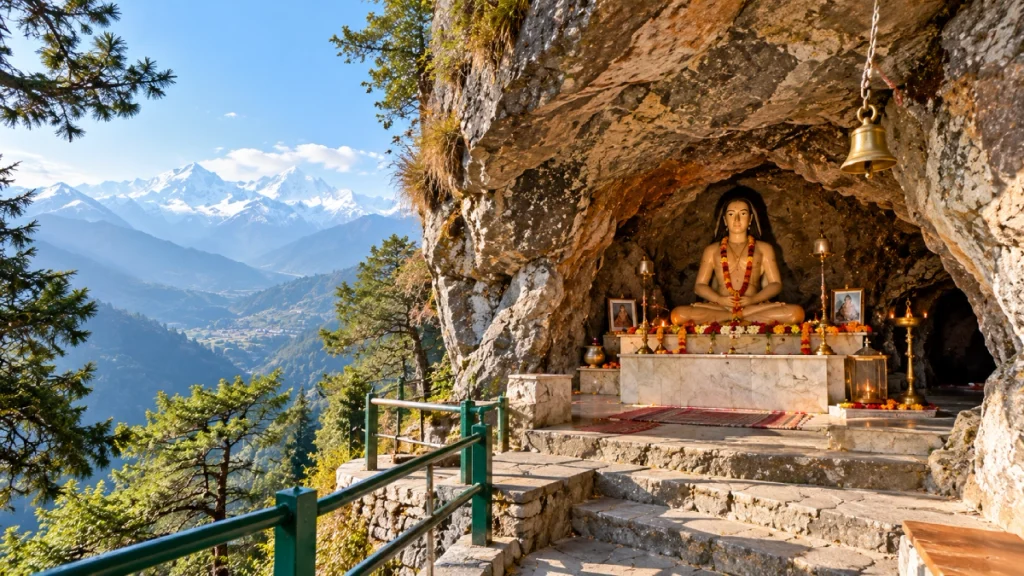
The cave itself is a modest rock shelter, small enough that you may have to stoop to enter. Its power lies in its story: this is where, according to Autobiography of a Yogi, Mahavatar Babaji initiated Lahiri Mahasaya into Kriya Yoga, reviving the practice for the modern world. Most visitors simply sit in meditation, inside or on the rocks outside. Keep silence, carry nothing you will leave behind, and give others their turn inside.
Optional: Pandavkholi
Fit trekkers can continue about 3–4 km further uphill to Pandavkholi, a high meadow where, by legend, the Pandavas hid during their exile. It adds 3–4 hours, so only attempt it if you are happy reaching Bageshwar after dark.
Afternoon drive to Bageshwar
Descend by late morning and drive to Bageshwar, around 100–110 km, with two excellent stops on the way.
- Kausani: A ridge-top village with one of Kumaon’s widest views of Trishul, Nanda Devi and Panchachuli. Visit the Anasakti Ashram, where Gandhi stayed in 1929, and sip local tea from the Kausani estates.
- Baijnath temples: A cluster of Katyuri-era temples on the banks of the Gomti, with the Parvati idol in the main shrine and a lake full of fish beside the complex.
Bageshwar
Bageshwar is located at the confluence of the Saryu and Gomti rivers. In the evening, visit the Bagnath temple, dedicated to Shiva as the tiger lord, and watch the lamps along the ghats at the sangam. The Chandika temple on the hill above offers a view over the whole town.
Day 4: Bageshwar to Dharchula
This is the longest mountain drive of the trip, around 190 km and 7–8 hours, so leave right after breakfast. The road winds from the Saryu valley into the remote eastern corner of Kumaon, where Uttarakhand meets Nepal and Tibet.
Route: Bageshwar → Kanda → Thal → Didihat → Ogla → Jauljibi → Dharchula. Some drivers prefer the route via Chaukori and Berinag; ask locally which road is in better shape after the rains.
Stops along the way
- Chaukori or Berinag (if routed that way): Tea-garden ridges with a panoramic sweep of the Panchachuli and Nanda Devi ranges.
- Thal: A small town on the Ramganga river with the old Baleshwar Shiva temple beside the water.
- Didihat: A quiet hill town above the Ramganga valley, good for a tea break and a stretch.
- Jauljibi: The confluence of the Gori and Kali rivers, famous for its centuries-old November trade fair where Indian, Nepali and Bhotiya traders once met.
From Jauljibi, the road follows the roaring Kali river, the border with Nepal, all the way to Dharchula. Watch the villages on the Nepali bank just across the water.
Suggested Read: How to Reach Bageshwar Dham from Delhi?
Arriving in Dharchula
Dharchula, at roughly 900 m, is the last sizeable town before the high valleys of Byans, Darma and Chaudans. It is the base for the Adi Kailash and Om Parvat yatra and, historically, the Kailash Mansarovar route. Check in, walk the riverside market and rest well.
Days 5–6: Two days in Dharchula
Two full days here let you slow down after the long drives and choose between a gentle local circuit and a big high-altitude excursion.
Day 5: Narayan Ashram and Tawaghat
- Tawaghat: About 18 km up the valley, where the Dhauliganga meets the Kali. The confluence is dramatic, with the gorge closing in on both sides. The NHPC Dhauliganga dam is nearby.
- Narayan Ashram: Founded in 1936 by Narayan Swami, this peaceful ashram sits at around 2,700 m above Tawaghat, surrounded by apple orchards, flower gardens and views of the high ridges. It once served as a rest stop for Kailash Mansarovar pilgrims and runs a small school for local children. Allow a few hours to sit in the meditation room and walk the grounds.
Carry warm layers; it is noticeably colder at the ashram than in Dharchula.
Day 6: Riverside Dharchula, or a high-valley excursion
For a relaxed day:
- The Kali river and the suspension bridge: A footbridge links Dharchula with Darchula in Nepal. Indian citizens can usually cross on foot with valid ID; carry your Aadhaar or voter ID and check the timings at the border post.
- Local markets: Look for woollen shawls, carpets and handicrafts made by the Rung (Bhotiya) community of the upper valleys.
- Riverside walks: The evenings by the Kali, with lights coming on across the river in Nepal, are among the most memorable moments of the trip.
For the adventurous: Adi Kailash and Om Parvat. With an early start and a local 4×4, some travellers attempt the drive towards Gunji and Om Parvat, or Jolingkong for Adi Kailash. This needs an Inner Line Permit from the SDM office in Dharchula, a medical certificate, and realistically more than one day, with a night at Gunji or Nabi. If this interests you, apply for the permit on arrival on Day 4 and plan around it; otherwise treat it as a reason to return.
Day 7: Dharchula to Tanakpur
Another long day, roughly 240 km and 9–10 hours, as you descend from the border hills to the edge of the plains. Leave by 6–7 am and pick two or three of the stops below rather than trying them all.
Route: Dharchula → Jauljibi → Askot → Pithoragarh → Ghat → Lohaghat → Champawat → Tanakpur.
Places to explore on the way
- Askot: Home to the Askot Musk Deer Sanctuary and the old seat of the Pal rajas, with forested slopes rising above the road.
- Pithoragarh: Often called the “Mini Kashmir” of Uttarakhand for its bowl-shaped valley. Visit the old Pithoragarh fort built by the Gorkhas and the Kapileshwar Mahadev cave temple just outside town.
- Lohaghat and Mayawati Advaita Ashram: About 9 km from Lohaghat, the Ramakrishna Order’s Advaita Ashram was founded in 1899 at Swami Vivekananda’s inspiration. Set in deodar forest with Himalayan views, it is a fitting spiritual stop on a spiritual journey.
- Champawat: The former capital of the Chand kings. The Baleshwar temple complex is a fine example of Chand-era stone carving. Champawat is also known from Jim Corbett’s first man-eater hunt.
The final stretch drops steeply through forest to Tanakpur, on the Sharda river at the Nepal border.
Read This Too: Why Chakrata should be on your next hill station stop?
Tanakpur in the evening
If you arrive with time and energy, walk along the Sharda. Tanakpur is the base for the Purnagiri temple, about 20 km away, one of the region’s most important Shakti shrines, reached by a final climb on foot. It is a better fit for an early start tomorrow than a late arrival tonight.
Day 8: Tanakpur to Delhi
The final leg is around 330 km and 8–9 hours via Khatima or Pilibhit, Bareilly, Moradabad and NH9 into Delhi, ending with a drop at the railway station.
If you want one last darshan: Start at dawn for Purnagiri, return to Tanakpur by 9–10 am, and then head for Delhi. Factor this into your train timing; it is only realistic if your train leaves late in the evening.
Otherwise: Stop briefly at the Sharda barrage near Banbasa for a last look at the river before the plains take over.
Build in a buffer of at least 2–3 hours for traffic on the approach to Delhi, especially around Ghaziabad in the evening.
Practical tips for the trip
- Best time: Late September to November and March to June. Early October brings clear skies and pleasant days, with cool nights above 1,500 m.
- Roads: Hill roads beyond Bageshwar can have landslide patches after the monsoon. Hire an experienced local driver, avoid driving after dark, and check road status each morning.
- Packing: Good walking shoes for the cave trek, a light fleece and a warm jacket for Narayan Ashram, rain cover, a torch, a refillable water bottle and basic medicines, including motion-sickness tablets.
- Documents: Carry original photo ID at all times, both for hotel check-ins and for crossing to Darchula in Nepal. The Inner Line Permit is needed only for Adi Kailash and Om Parvat.
- Connectivity and cash: Mobile signal is patchy near the cave and in the upper Dharchula valleys, and ATMs can run dry. Carry enough cash from Bageshwar onwards.
- Stays: Book ahead near Kainchi Dham and Dwarahat, where options are limited. KMVN (Kumaon Mandal Vikas Nigam) tourist rest houses are dependable along most of this route.
- Etiquette: Dress modestly at temples and ashrams, keep silence at the cave, follow photography rules, and carry all plastic back out of the forest.
Closing thoughts
This route is less a checklist of sights than a slow ascent: from the lakes of Bhimtal to Maharaj-ji’s valley, to the stillness of Babaji’s cave, and out to the wild Kali river frontier. Travel it unhurried, leave room for silence, and you will likely come home with more than photographs.
If you have taken this journey, or are planning it, share your experience and questions in the comments.
FAQS
Where is Mahavatar Babaji Cave located?
The cave is in the Kumaon hills of Uttarakhand, in Almora district, above the village of Kukuchina near Dwarahat. It lies on the forested slopes of Dunagiri, roughly 20 km beyond Dwarahat, and is reached by a short uphill walk from the Kukuchina roadhead.
Is Mahavatar Babaji Cave real?
Yes, the cave is a real, physical place that thousands of pilgrims visit every year. What it represents is a matter of faith. The story of Mahavatar Babaji initiating Lahiri Mahasaya into Kriya Yoga here in 1861 comes from Paramahansa Yogananda’s Autobiography of a Yogi, published in 1946.
Lahiri Mahasaya himself is a well-documented historical figure. He worked as an accountant in the military engineering department and was posted to Ranikhet in 1861, which fits the story. Babaji, however, is described as a deathless yogi who appears only to a chosen few, so his existence cannot be verified historically. Devotees accept the account on faith, while others visit simply for the peace and beauty of the place.
Who was Mahavatar Babaji?
In the Kriya Yoga tradition, Mahavatar Babaji is revered as an immortal Himalayan master who revived the ancient technique of Kriya Yoga. He passed it to Lahiri Mahasaya, whose disciple lineage leads through Sri Yukteswar to Paramahansa Yogananda, founder of the Yogoda Satsanga Society of India (YSS) and the Self-Realization Fellowship (SRF).
How do I reach Mahavatar Babaji Cave from Delhi?
The cave is around 380–400 km from Delhi by road, covered over two days via Haldwani, Kathgodam, Bhowali, Ranikhet and Dwarahat. The nearest railway station is Kathgodam, about 120 km away, and the nearest airport is Pantnagar. From either, hire a taxi to Dwarahat or Kukuchina.
How long is the trek to the cave, and is it difficult?
The walk from Kukuchina is about 2.5–3 km one way on a paved stone path, climbing steadily through forest. Most people take 1 to 1.5 hours up and less coming down. It is moderate rather than difficult, but the continuous climb can tire those not used to hills.
Can elderly people and children visit the cave?
Yes, most families and older visitors manage it by walking slowly and resting often. Anyone with heart, knee or breathing problems should consult a doctor first. Porters or ponies may sometimes be available locally, but do not count on it.
Is there an entry fee or fixed timing?
There is generally no entry fee to visit the cave. It is best visited in daylight, and most visitors aim to start early and be back at Kukuchina well before dark, as the forest path is unlit and wildlife is present.
Can I meditate inside the cave?
Yes, many visitors sit quietly in meditation inside the cave or on the rocks outside. The cave is small, so keep your time inside short when others are waiting, and maintain silence.
Is photography allowed at the cave?
Photography of the surroundings is common, but keep it discreet and respectful near the cave, and avoid photographing people meditating. Follow any signs or instructions from caretakers.
Where can I stay near Babaji Cave?
Dwarahat has the most options, including guesthouses, homestays and a KMVN tourist rest house. Simple stays are also available near Dunagiri and Kukuchina. YSS runs an ashram in Dwarahat, primarily for its members and retreat participants; contact YSS directly to ask about availability.
What is the best time to visit?
March to June and September to November offer the most comfortable weather and clear views. The monsoon, July to August, brings slippery paths and landslide risk on the roads. Winters are cold, and the trail may occasionally see frost or snow.
What is Pandavkholi, and is it connected to the cave?
Pandavkholi is a high meadow about 3–4 km above the cave, where, according to legend, the Pandavas hid during their exile. Many pilgrims continue there after visiting the cave, but it adds a steep 3–4 hours to the round trip.
Is Babaji Cave related to Kainchi Dham?
No. Kainchi Dham is the ashram of Neem Karoli Baba, a different saint of the 20th century. The two are often combined in one trip because they are both in Kumaon, only a few hours apart.
